
How to Search the Teller County Court Docket
Start with the state's own tool: the free Teller-filtered Colorado Docket Search. It shows scheduled settings for state-court hearings. It is not the full Register of Actions. Before searching, read the court named on your ticket, notice, or pleading, because the Teller County court docket does not carry every municipal citation. The state form also demands a date plus at least one more filter. County, case number, party, attorney, or division all work.
Pick the shortest route for the job. The online calendar answers when and where a hearing happens. An approved commercial vendor carries real-time ROA index data. For an official ROA, a named filing, or a certified copy, the Clerk of Court, Teller County Combined Court is the office to contact. When online access falls short, in-person inspection and retrieval of older files remain open.
- Read the document for the court name and case number.
- Select Teller and a short date range on the state docket form.
- Add a case, party, attorney, court, or division filter.
- Check the newest unvacated date, hearing type, room, and appearance field.
- Use an approved ROA vendor or the Teller clerk for the case history and documents.
Teller County Docket or ROA?
Think of the free Teller County court docket as a calendar. One row can list the hearing date, start time, scheduled duration, caption, case number, hearing type, location, appearance mode, and division. That is all. The pleadings sit behind that setting. So does the charge detail, the financial ledger, and the downloadable documents. A search result is one hearing row. It is never the whole case file. Several rows may belong to the same matter. An old date can even linger after a later reset.
The Register of Actions is different. Colorado requires this chronological summary for every filed case. It records the main events, settings, minute orders, charges or civil type, disposition, and sentence where applicable. Approved vendors get real-time index data. Yet Colorado warns that vendor data is not the official court record and carries no document copies. When accuracy or authentication matters, ask the clerk for the ROA.
Quick distinction: use the docket to confirm a setting, the ROA to trace the case, and the clerk to obtain the actual filing.
What a Court Docket Shows
A Teller County docket entry ties a case's identity to a scheduled event. The case number usually mixes three parts. It carries a four-digit year, class letters, and a sequence. Those class letters separate felony, misdemeanor, traffic, district civil, county civil, and small-claims matters. The caption names the public parties and their roles. The setting data then tells you what is due to occur. It also shows where the event belongs.
| Case Number | Year, class, and sequence, such as 2026CR... or 2026CV.... |
|---|---|
| Parties | The public caption and party roles for the case. |
| Event History | Filings, minute orders, notices, resets, and outcomes indexed in the ROA. |
| Hearing Setting | Date, time, duration, hearing type, courtroom or division, and appearance mode. |
| Court | Teller District Court, Teller County Court, or the municipal court named on the case. |
| Disposition | The recorded outcome, which should be checked against the signed order when proof is needed. |
A blank appearance field grants no remote-attendance permission. The word VIRTUAL only describes the listed setting. It cannot replace a judge's order or the division's direction. When online rows conflict, the newest operative notice and the clerk's confirmation control.
Teller County Court Docket Codes
Colorado case numbers make a Teller County court docket search easier to narrow. The public form splits year, class, and sequence into separate fields. Enter each part where it belongs. A class is a docket family, not a result. It tells you where the matter sits. It also hints at what type of process is likely. It says nothing about whether a claim or charge was proved.
- CR
- Felony criminal cases in Teller District Court.
- M
- Misdemeanor matters generally handled in Teller County Court.
- T
- State traffic cases and infractions assigned to the county court.
- CV
- District civil cases and other general-jurisdiction civil matters.
- C
- County civil cases, including money claims within the court's limit.
- S
- Small-claims cases handled in the county court.
Municipal citation numbers do not always follow the state classes. A no-match result may simply mean the wrong court. Check whether the ticket names Woodland Park Municipal Court or Cripple Creek Municipal Court before changing any spelling or date range.
Which Courts Keep Dockets
Teller County District Court and Teller County Court share one state courthouse. They also share a single Combined Court clerk's office. Their case classes stay distinct. So the street address alone cannot tell you which docket holds your case. Felonies, major civil matters, domestic relations, probate, and juvenile cases sit in District Court. Misdemeanors, state traffic, eviction, small claims, and county civil matters sit in County Court. City-code cases stay with the two municipal clerks.
| Court | Docket Covers | Where to Search |
|---|---|---|
| Teller County District Court | Felony, district civil, domestic, probate, and juvenile matters | Colorado Docket Search, ROA vendor, or Combined Court clerk |
| Teller County Court | Misdemeanor, traffic, eviction, small claims, and county civil matters | Colorado Docket Search, ROA vendor, or Combined Court clerk |
| Woodland Park Municipal Court | Woodland Park ordinance, municipal traffic, and municipal criminal cases | City citation, coordinator, phone, or City Hall counter |
| Cripple Creek Municipal Court | Cripple Creek code, traffic, and municipal criminal cases | City calendar, municipal clerk, or City Hall counter |
An appeal can generate a new court number and fresh entries for a notice, record transmission, or remand. Matching captions never prove two records are the same case. When a matter changes courts, ask the clerk for the cross-reference.
Two Teller County Docket Clerks
The phrase Teller County Clerk can mislead. It can lead you to the wrong desk. Sheila Griffin is the state Clerk of Court. She also serves as Jury Commissioner for the Teller Combined Court. That Judicial Branch office creates and keeps the state trial-court file. It maintains each Register of Actions. It records orders and dispositions, supplies copies, and certifies documents. The elected Teller County Clerk and Recorder handles land records, elections, marriage, and motor-vehicle records instead.
Both offices share ties to the same historic site. The mix-up is easy to make. A land-record search reaching back to old recordings can look like a broad public-record portal. It is not a Teller County court docket. For a District Court or County Court case file, ask for the Combined Court Clerk. Municipal cases go through the separate city clerk or coordinator.
The Teller County Clerk and Recorder page shows the non-court office and its courthouse history. Its role explains the confusion. Recording results can never substitute for a criminal, civil, or traffic ROA.
Finding Court Dates and Settings
The Teller County court docket blends statewide search rows with local schedule notices. Division 11 settings land on Tuesday and Wednesday mornings. Rule 120 hearings get a Monday block. County Court money-demand returns run on a Wednesday schedule. Probate and eviction matters, by contrast, follow their own local timing. An older web notice may conflict with a signed order. In that specific case, the order controls.
Confirm the latest notice or order first. Then compare it against the Colorado docket row and the ROA, looking for any continuance, reset, or vacated event. Note the date, time, hearing type, courtroom, and how you must appear. Anything that conflicts deserves a call to the assigned division or the general clerk. The full Teller County court calendar walks through each setting field and every way to confirm a court date.
The statewide Colorado docket form also searches by party or attorney. Keep the county and date range tight. Common names can pull up several unrelated hearing rows.
Teller County Dockets in Mountain Weather
Weather belongs in every Teller County court-date check. The Judicial Branch courthouse page reports current closures and delays. Cripple Creek goes further. Its municipal session meets weather permitting. A docket row built earlier can lag behind a same-day building change. Recheck official notices before any mountain drive. That matters most when a session rides on a fixed monthly date.
Teller Division T has an official virtual-room page. But seeing the link does not approve you to appear online. A blank appearance field is not remote permission either. Follow the latest order or a direct instruction from the division. And when a governing notice or order says so, recording or reproducing a streamed or courtroom proceeding is prohibited.
The official courthouse page carries current visitor and closure information, and its public view also displays the historic court building that both state trial courts use.
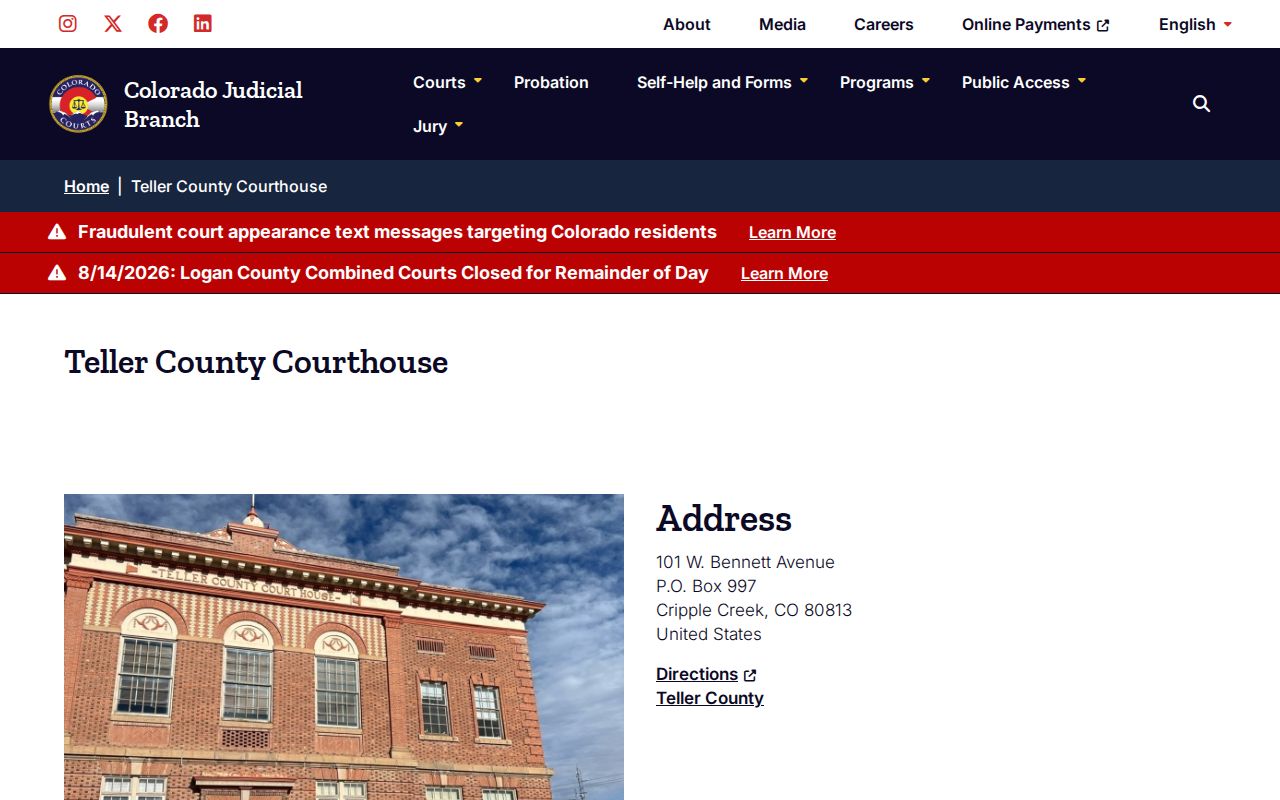
The image connects the online status check with the building where state case files are inspected and certified.
Public Access to Dockets
Public access in Colorado has limits. Not every Teller County court record sits on the open web. What you can reach from home is narrower than what a court facility offers. The public calendar exposes hearing data. Approved vendors supply real-time ROA index data, while the clerk controls official copies and documents. Some material may be withheld, redacted, or limited. That covers sealed, suppressed, juvenile, probate, and protected records, and access can be limited to an authorized person.
Key rules:
Chief Justice Directive 05-01 governs public access, remote limits, exclusions, and vendor duties for Colorado court records.
PAIRR 1 and the Judicial Access Guide set the court-record access framework and distinguish case files from administrative records.
C.R.S. sections 24-72-304 and 24-72-305 allow limits on criminal-justice records where law, court rule, order, or public interest requires them.
A missing public result never proves a case does not exist. The record may sit in another court, be stored off site, fall under a different class, sit outside your date range, or be lawfully restricted.
When a Teller County Docket Is Missing
Start with routing, not guesses. Confirm the spelling and the court printed on your source document. Only after checking the county, division, and case class should you widen the date range. A Woodland Park or Cripple Creek citation may actually belong to municipal court. A federal matter will never surface in the Colorado state search. An old state file may need off-site retrieval.
Still nothing? Follow the access chain. Check an approved vendor for the ROA. Send the Teller clerk a precise request. You can also call the division or inspect the file at the counter. Ask whether a courthouse terminal exists before you travel, since current official sources do not promise its location. Offer identification only when the clerk directs it for protected, probate, juvenile, or suppressed material.
- Wrong name spelling or incomplete party name
- Wrong court, including municipal instead of state court
- Old or off-site file not exposed online
- Reset outside the selected date range
- Sealed, suppressed, juvenile, or protected record
The Clerk and Docket Records
The Clerk of Court, Teller County Combined Court keeps the official docket records for both state trial courts. You have several ways to request. Use the online Record/Document Request Form, the Teller routing page, email, phone, mail, or the courthouse counter. The form covers the ROA plus named criminal, civil, and probate documents, and it lets you ask for certification or exemplification. The stated response target is three business days unless circumstances require more time.
Mail goes to the court's post office box. Never place credit-card data on the printable form. Staff reviews the request and sends a Notice of Fees, and an assigned researcher can take card payment by phone. Ordinary research may arrive by email. Certified research goes by mail. Older files can add an actual retrieval cost, and a transcript follows the court reporter route rather than an ROA request.
Clerk of Court, Teller County Combined Court
101 W. Bennett Avenue, P.O. Box 997
Cripple Creek, CO 80813
719-689-7360
Monday through Friday, 8:00 a.m. to 4:00 p.m.
The Teller judges and staff directory identifies the clerk and resident divisions.
The directory ties each docket class to local court staff. Those staff can confirm a setting or route a record request.
Teller County Dockets Since 1904
The 1904 Teller County Courthouse bridges the paper era and the electronic one. Clerks once worked from bound registers, local indices, and case jackets. Colorado's current rule still requires a Register of Actions for every filed case. The working record is electronic now. An off-site retrieval charge remains possible. That possibility shows that older material never became an instant online record.
Modern access splits the work. Colorado Courts E-Filing receives attorney filings and selected non-attorney filings. It is not the public docket. The Judicial Branch publishes the free hearing calendar, and approved vendors receive real-time ROA data. Filed documents stay with the Teller clerk. That split keeps any one portal from answering every request. Yet it also gives each channel a clear role.
The official Teller court landing page gathers local notices, schedules, virtual rooms, and docket access in one spot.
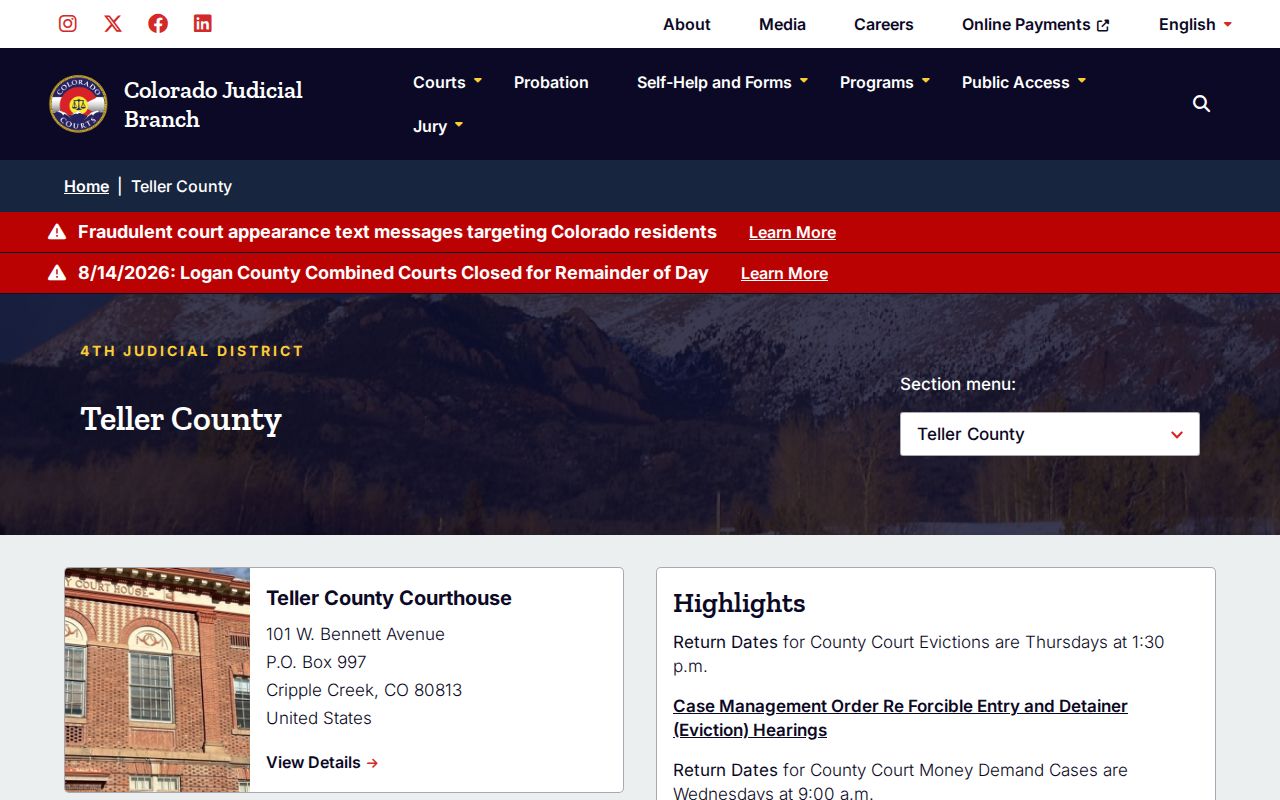
The official page there shows why current local notices belong beside any statewide docket result.
Teller County Docket Activity
How busy is this court? The state keeps count. Colorado's Judicial Branch research library tracks filings across every judicial district, and its FY2024 statistical report puts Teller County Court at 2,092 filings that year. It closed even more, logging 2,191 terminations. The workload splits into distinct dockets. Misdemeanors accounted for 476 cases and traffic for 478. Civil matters came to 482, infractions 605, small claims 21, and the felony statistical category 30. Every category creates its own docket search need, since a criminal docket entry looks different from a civil one.
Terminations topping filings is a good sign for inventory. It suggests the court worked down its pending cases that fiscal year. But the report has limits. It cannot tell you the age of any single case or measure true backlog. Nor will it predict when a new filing gets a hearing date. For that, look deeper. Check the case-specific Teller County court docket and the assigned division. Those show actual settings.
Court Dockets by City in Teller County
Two incorporated cities in Teller County run their own municipal courts. Woodland Park handles city Charter and ordinance matters, including certain traffic and criminal violations. Cripple Creek covers municipal code, traffic, and criminal violations. Neither city offers a general public case-search form. A local docket lookup therefore starts with the citation. It also draws on the city calendar or session schedule, and the municipal clerk. State charges skip both cities and route to the Teller Combined Court instead.
Woodland Park Court Docket
2020 population: 7,920
Municipal sessions are generally held on the second and fourth Wednesdays.
Cripple Creek Court Docket
2020 population: 1,155
Municipal court generally meets on the second Wednesday, weather permitting.
Read the issuing court printed on your ticket before anything else. That line decides the venue. City police can write tickets for matters that actually belong in Teller County Court, not the municipal docket.
Map and Directions to the Teller County Courthouse
Both Teller County District Court and County Court files are kept at the Teller County Courthouse, 101 W. Bennett Avenue, in downtown Cripple Creek. The building dates to 1904 and also houses the elected County Clerk and Recorder's land-record office, so visitors should ask for the Combined Court Clerk rather than Recording when they need a case docket, a Register of Actions, or a certified judgment.
Teller County Courthouse
101 W. Bennett Avenue, P.O. Box 997
Cripple Creek, CO 80813
719-689-7360
Monday through Friday, 8:00 a.m. to 4:00 p.m.
Security, parking, and public-terminal placement are not covered in any official visitor notice, so calling 719-689-7360 before a trip is the surest way to confirm entry procedures. Bring the case number and party names, and expect a government-issued photo ID request for juvenile, probate, or otherwise restricted files.