
How to Search Civil Dockets
The Teller-filtered Colorado Judicial Branch Docket Search is the quickest way to find scheduled civil hearings. Pick Teller as the county. Keep the date range short. Then add at least one filter, such as a case number, party, attorney, courthouse, or division. The form also accepts a four-digit filing year. A civil class like CV, C, or S works too, along with the numeric sequence that follows. Searching by party? An individual or business name both work.
What you get free is a calendar entry, nothing more. It lists the date, time, duration, caption, case number, hearing type, location, appearance field, and division. It will not open the complaint, the motions, or the judgment. For a live Register of Actions, Colorado sends the public to approved vendors. Even a vendor ROA is informational only. Copies of documents come from the Teller County Combined Court clerk.
- Read the pleading or notice for the court, division, case number, and civil class.
- Search the state docket with Teller, a narrow date range, and at least one added filter.
- Review the newest setting, then check the ROA for any later notice, reset, minute order, or vacated event.
- Use the vendor index to identify a filing by title and date, not as a substitute for the filed paper.
- Use the Record/Document Request Form for the ROA, an order, a judgment, or another named filing.
Need more than the online calendar shows? The Teller County clerk takes requests four ways. Email tellerclerkgeneral@judicial.state.co.us, call 719-689-7360, mail the printable form to P.O. Box 997, Cripple Creek, CO 80813, or simply view the court file at the counter. Call ahead about a public terminal. Some older records sit off site and take longer to pull.
Note: The free Teller County civil docket calendar stops at the schedule. No filed complaints, motions, exhibits, or judgments appear.
Teller County Civil Docket Case Lanes
Class letters sort each Teller County civil docket into its lane. District civil cases carry CV. County civil cases carry C, and small claims carry S. One Combined Court clerk serves both the District Court and County Court, so neither civil file has a separate elected county clerk.
| Case lane | Scope | Local court |
|---|---|---|
| CV | General civil matters beyond County Court limits and other District Court jurisdiction | Teller District Court, Division 11 |
| C | Money cases through $25,000, eviction, and related County Court civil matters | Teller County Court, Division T |
| S | Small claims through $7,500 | Teller County Court, Division T |
Domestic and probate cases belong to the District Court family. Their access rules can differ from ordinary civil files. Municipal courts do not hear private civil claims at all. A civil party digging through a City Hall municipal docket is in the wrong system. Unless the dispute is truly a city-code matter. In Teller County, the case type sets the civil class and division. The shared courthouse does not.
Note: Case type, not the shared courthouse building, determines the Teller civil class and division.
What a Civil Docket Shows
Every filed case in Colorado gets a Register of Actions, a chronological index of its entries. The Teller County civil ROA links the case number and status to the parties, court events, hearing entries, and public outcome information. It is not a stack of document images. The clerk's request menu makes this clear. An ROA, Order for Judgment, Transcript of Judgment, Satisfaction of Judgment, and Protection Order are listed one by one. Each is a separate record.
| Case header | CV, C, or S class, year and sequence, Teller court and division, status, and filing date. |
|---|---|
| Parties | Plaintiff or petitioner, defendant or respondent, and public attorney information. |
| Opening events | Complaint or petition, summons, service or return, and answer. |
| Case activity | Motions, responses, notices, hearings, and minute orders. |
| Outcome | Trial, dispositive order, judgment, dismissal, satisfaction, enforcement, or appeal entries. |
| Documents | The named papers remain behind the index and must be requested from the clerk. |
Read entries in pairs when you can. A motion only means a party asked for relief. It never proves the judge granted it. A minute order may record an action yet still not replace the signed final judgment. When the legal effect matters, get the exact filed document.
Teller County Civil Docket Motion Checks
The classic mistake is treating a filed motion as the ruling itself. Find the motion first. Then scan ahead on the Teller County civil docket for a response, hearing, minute order, or signed order that resolves it. A closed label creates the same trap. It does not say whether a dismissal was voluntary, based on inactivity, or on the merits. Read the dismissal order before concluding anything.
Service entries need equal caution. A summons issued entry shows process started, not that the other side actually received it. Track down the service or return entry before treating any later default as established. Default judgment means relief was entered. It follows a failure to respond or defend under the applicable process. It never follows automatically from filing a complaint.
If service seems missing: Verify the party roles and case class, search for a later return, and ask the Teller clerk for the ROA or filed proof of service.
Captions can mislead too, since the original plaintiff and defendant labels may survive a counterclaim. Post-judgment work adds its own layer. A Transcript of Judgment, Satisfaction, writ, or notice of appeal is a later event. It is not the original judgment itself.
Note: Match each civil motion to its later order. Do not treat the request as granted or denied before then.
Types of Civil Cases on the Docket
Civil dockets in Teller County cover several case families. The court and class differ among them. County Court takes money demands within its civil limit, small claims, evictions, and related matters. District Court is the general-jurisdiction lane for bigger disputes. Domestic and probate cases also sit in District Court families. Extra limits apply to some records and documents.
| Matter | Likely Teller docket lane | Record clue |
|---|---|---|
| General district civil | District Court CV | CV class and Division 11 |
| County money claim | County Court C | C class and Division T |
| Eviction | County Court civil | Return and trial entries under the local management order |
| Small claims | County Court S | S class |
| Domestic or probate | District Court family | Special case class and possible access limits |
A transfer or appeal can spawn a new court number. Watch for transfer, notice of appeal, record-transmission, or remand entries, and ask the clerk for cross-reference data. Similar captions alone cannot prove two records are the same case.
Teller County Civil Rule 120 Docket
Rule 120 cases in Teller County District Court sit in Division 11. They draw a standing Monday slot at 8:30 a.m. Think of Rule 120 as the foreclosure lane of the civil docket. A standing time never settles what happens in a case. The current notice and the case order control the actual date. They also decide whether you must appear.
Run a Teller County civil docket search with the case number, a party name, and a short date range. Add Division 11 when you have it. Then open the ROA. A notice, order, continuance, or vacated setting there can push aside the standing schedule. If anything conflicts, confirm with Division 11 before you rely on the calendar.
Teller County Civil Docket Filing Mix
How busy is this court? The Colorado Judicial Branch's FY2024 report offers scale, not a forecast for any single case. That year Teller County Court took in 482 civil filings and 21 small-claims filings. It closed out 537 civil cases and 26 small-claims cases. A termination is just a statistical event. It proves neither that claims ended at trial nor that a pending matter will move at the same pace.
The numbers tell you one thing. The Teller County civil docket mixes ordinary civil work with small claims. Nothing more. They measure no backlog, explain no dismissal, and predict no outcome. For one case, the ROA and the signed court records still rule.
Teller County Civil Docket Judgments
A judgment entry on the Teller County civil docket signals the court's ruling. The signed judgment itself is a separate document. An Order for Judgment states the relief granted. A Transcript of Judgment is a certified summary used to record or enforce the judgment, and a Satisfaction of Judgment shows the obligation has been met.
Read post-judgment entries in time order. A later transcript, writ, satisfaction, or appeal never rewrites the original judgment. When exact terms matter, find the signed order by date and title in the ROA, then request that document from the Teller clerk.
Settings and Hearings on Civil Dockets
A Teller County civil docket may carry a notice of hearing, a return date, a status setting, or a trial. It may also carry an order that shifts an earlier setting. County money-demand returns land on Wednesdays at 9:00 a.m. Division 11 Rule 120 matters sit on Mondays at 8:30 a.m. Standing times help you read a calendar result. But the latest order or case notice always wins.
For any civil court date, search the state calendar. Note the date, time, duration, hearing type, division, and appearance field. Then scan the ROA for a reset or a vacated entry filed later. A blank appearance field approves nothing about appearing remotely. The Teller County trial-court page posts local notices plus closure and delay status.
When schedules clash, the signed case order settles it. Call Division 11 at 719-689-6926 if an older calendar result conflicts with a notice. The Division T general clerk sits at 719-689-7360. Mountain weather can close the courthouse. So check the court's closure banner on the day of the setting.
Note: A blank calendar appearance field does not authorize a remote appearance in a Teller County civil case.
Teller County Civil Docket Eviction Returns
Eviction returns and trials in Teller County Court run under a signed Division T management order dated August 26, 2025. It allows in-person or Webex proceedings. For a remote trial, exhibits must be filed and served at least two days before trial. Plaintiffs number their exhibits. Defense exhibits start with letters.
Those rules can generate several distinct docket entries: the return setting, appearance notices, filed exhibits, the trial setting, and later orders. A Webex option in the order does not make remote the default for everyone. Read the order and the case notice first. If an appearance instruction stays unclear, confirm it with Division T.
Indexed local notices have disagreed on the weekly eviction return day. So a generic schedule should never trump the current signed management order or a case-specific notice. The statewide docket confirms the published setting. The ROA records later resets and any court action.
Note: Remote-trial exhibit rules govern filings and service, not the public's right to open a protected exhibit.
Public Access to Civil Dockets
Teller County civil dockets stay open for inspection at reasonable times. A law, rule, directive, or court order may limit access. What you can reach remotely may be narrower. It may not match what you can see at the courthouse. Vendor index data is not the official court record. The Judicial Branch notes that approved vendors do not hand out copies of filed documents. For the actual order, judgment, or other filing, the Teller clerk supplies it when release is allowed.
Key Rules:
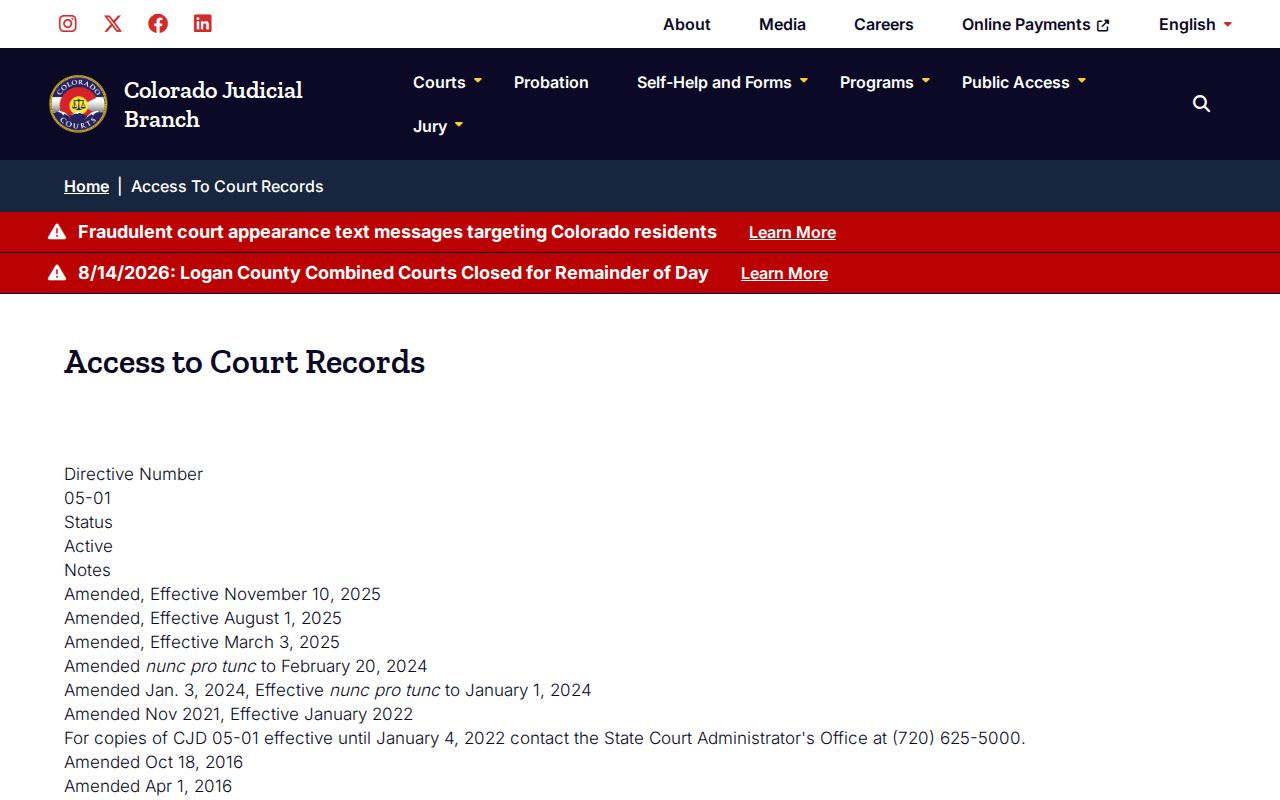
Chief Justice Directive 05-01 governs public court-record inspection, remote access, exclusions, vendor duties, and compiled data.
PAIRR 1 and the Judicial Branch Access Guide frame access to judicial case files and distinguish them from administrative records.
Colorado Rule of Civil Procedure 121 section 1-5 governs court orders that limit public access in civil cases.
Suppressed civil cases or filings may be left out or flagged as restricted. Redaction can strip personal identifiers. It can also remove medical information, financial-account material, and other protected content. Probate, domestic, juvenile, adoption, dependency, and mental-health records may carry extra limits. Staff can demand ID from an authorized requester. Even then release is not promised.
Teller County Civil Docket Off-Site Files
Some older Teller County civil docket entries never made it online. That gap usually means storage, not secrecy. The clerk can pull an off-site file for you. Any real retrieval cost gets assessed at that point. To speed things up, give staff the class, the filing year, and the sequence number. Add party names and the exact filing you want. Details help them tell an archived paper file apart from a live electronic entry.
Inspecting a file first can spare you from paying for pages you do not need. Access and redaction rules still apply. Call ahead and ask whether the file is on hand. Ask too whether electronic inspection is offered on site. If a web search comes up empty, work through the clerk before assuming the case is sealed.
Teller County Civil Docket Copy Paths
For the official rules behind Teller County civil docket access, the Colorado Judicial Branch public-access directive page is the assigned authority. It sets out what the public may reach and how.
The core rule is simple. A public index and a filed civil document sit on separate layers. Only the court can hand you an official copy. The Teller clerk's printable request and fee form lists what you can order: an ROA, an Order for Judgment, a Transcript of Judgment, a Satisfaction of Judgment, a Protection Order, plus a blank line for any other document you name.
Know what each paper is before ordering. A Transcript of Judgment is a certified summary used to record or enforce a judgment. A Satisfaction shows the judgment has been fulfilled. Neither one replaces the original signed judgment. That signed record is what your situation may demand.
How you get it back depends on what you asked for. Plain requests can come back by email, while certified research goes out by mail. The counter, mail, phone, and clerk email all work as ways to submit. The posted normal response target is three business days when nothing unusual slows things down. Files pulled from storage may add an actual retrieval cost.
A verbatim hearing record is a different animal. Ask the court reporter rather than filing an ROA request. If you are not a party, you must file a motion and win judicial approval under the Fourth District procedure first. County CORA requests also go to county executive offices. They cannot substitute for a judicial case-file request. The civil docket and its court documents live with the Combined Court clerk. They do not sit with the elected Teller County Clerk and Recorder.