
How to Get Court Records
Each filing stays with the court that received it. District Court and County Court files sit with the Clerk of Court, Teller County Combined Court. City ordinance cases are different. They remain with Woodland Park or Cripple Creek Municipal Court. The free Colorado Judicial Branch Docket Search lists hearings on the calendar, nothing more. An approved vendor can stream Register of Actions data in real time. But the state labels vendor data unofficial, and it never includes copies of filed documents.
Pick the channel that suits you. The clerk takes the state online form, email at tellerclerkgeneral@judicial.state.co.us, and phone calls at 719-689-7360. Mail works too. Send it to P.O. Box 997, Cripple Creek, CO 80813, or visit the counter at 101 W. Bennett Avenue. Call ahead about a courthouse terminal. A transcript must go through the court reporter or recorder process, not the records form.
- Find the court, case number, party names, and title or date of the filing.
- Use a Register of Actions to identify the exact order, judgment, ticket, or probate document.
- Choose the online form, email, phone, mail, or Combined Court counter.
- State whether each item should be plain, certified, or exemplified, and provide identification only when directed.
- Review the Notice of Fees, pay through the permitted channel, and choose pickup, email, or mail where offered.
Teller County Court Records Form
The Colorado Record/Document Request Form sorts requests by county. The Teller request page names the local recipient. Choose Teller County. Add contact and mailing details, then identify the case. Checkboxes split the options. They cover criminal disposition or sentence orders, protection orders, tickets, civil judgments, probate papers, and the Register of Actions. A free-text box lets you name any other filing and its date. Certification and exemplification are separate choices.
The official Record/Document Request Form screen shows why careful selections matter. They set the clerk's cost.
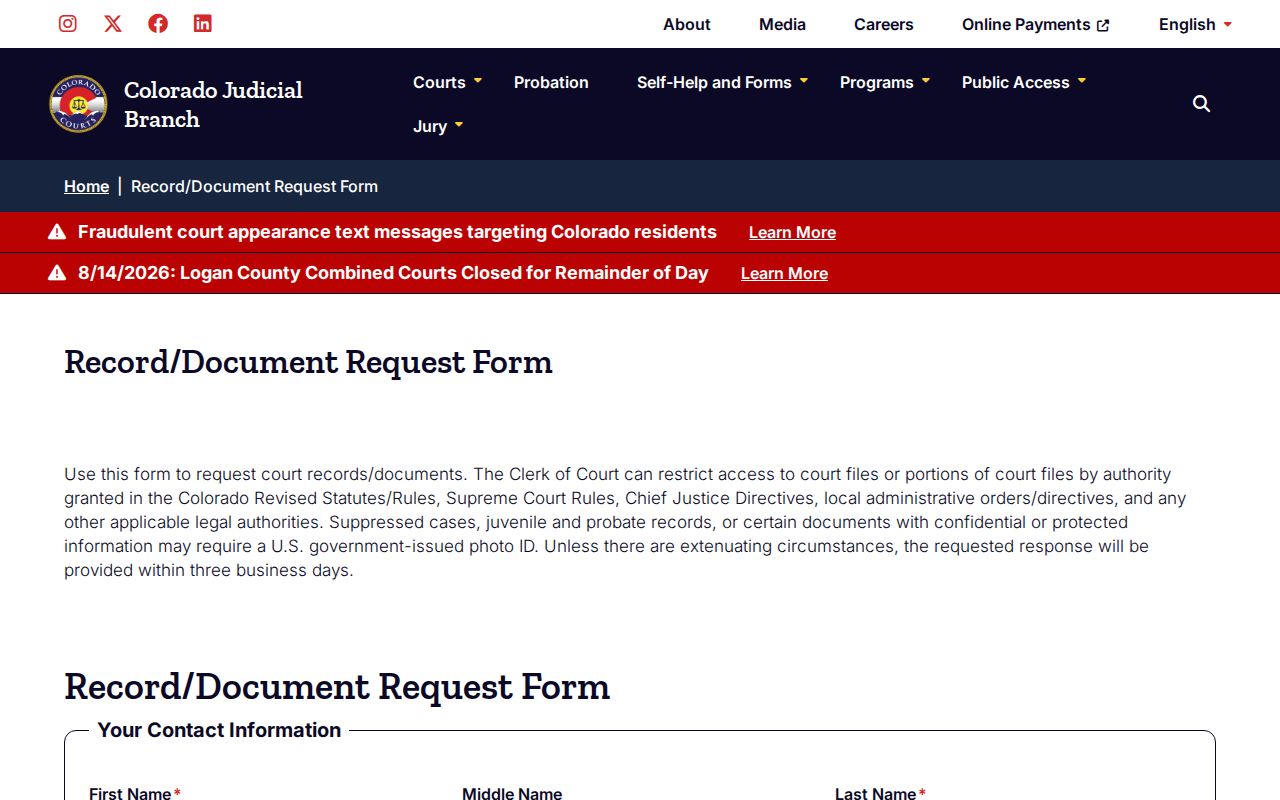
This path goes straight to the filing court. It skips the county government's general CORA channel. The Teller routing page also gives the local clerk email. Suppressed, juvenile, probate, or protected material may require a government-issued photo ID. Even then, sending ID does not guarantee release.
Types of Court Records
Teller County court records run from brief case histories to signed papers. A request must separate the index from the document itself. A calendar printout shows only a setting. It never proves how the case ended. The clerk's form covers these main record types:
- Register of Actions entries with events, charges, sentences, and minute orders.
- Criminal disposition or sentence orders, protection orders, and tickets.
- Civil orders for judgment, transcripts of judgment, and satisfactions of judgment.
- Probate letters, wills, trusts, applications, petitions, closing papers, and claims.
- Other named pleadings, orders, and exhibits that are open to the requester.
A verbatim record stands apart. When you need the spoken proceeding rather than the clerk's event summary or a filed order, the Fourth Judicial District's transcript procedure applies. The printable record request form is for clerk records, not a verbatim transcript.
Teller County Court Record Layers
Three layers answer three questions. The Register of Actions tracks what occurred across the life of the case. A filed document gives you the actual text. It might be a complaint, motion, order, judgment, ticket, or probate paper. For official use, the clerk can authenticate a certified or exemplified copy. Order the wrong layer and you may pay extra page charges or lose time.
| Record Layer | What It Provides | Best Source |
|---|---|---|
| Register of Actions | Chronological events and brief case explanation | Vendor for unofficial data; Teller clerk for a clerk copy |
| Filed document | The text of a named pleading, order, or judgment | Filing court |
| Certified or exemplified copy | Clerk authentication attached to the document | Teller Combined Court clerk |
Narrow the request before paying for pages. Use the free hearing search and the ROA to pin down the case number, title, and filing date. One signed order may answer the need, so skip asking staff to copy a whole file.
Teller County Federal Court Records
Federal cases travel a separate record chain. Teller County federal civil and criminal cases belong to the U.S. District Court for the District of Colorado, reached through PACER or the federal clerk, never the Teller Combined Court form. Teller sits inside federal Jury Division Four. Bankruptcy filings go to the U.S. Bankruptcy Court for the District of Colorado. Appeals climb to the Tenth Circuit. A Colorado state case never moves into PACER unless a distinct federal case, such as a removal, opens.
The Colorado Bankruptcy Court page covers that distinct federal docket.
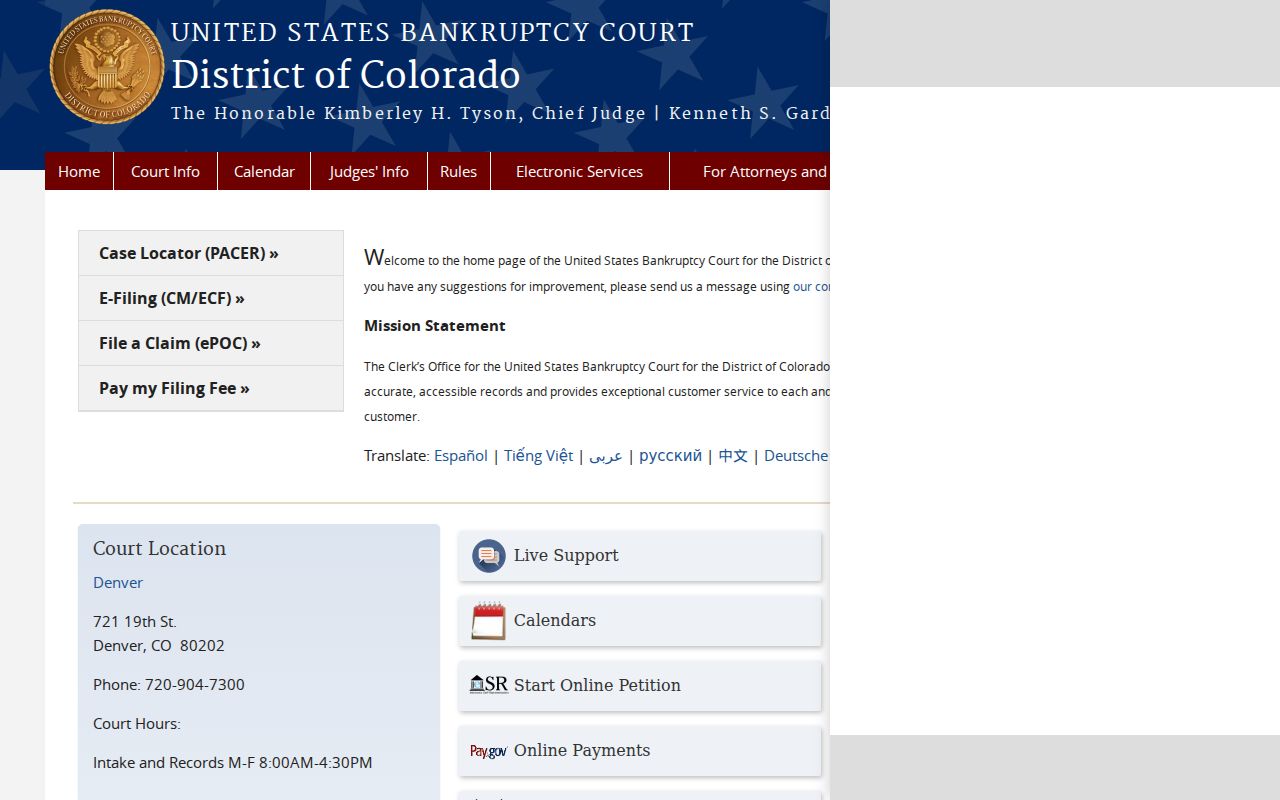
Those records live outside any Teller County District Court or County Court file. The boundary matters when a familiar party name returns no state result.
The Tenth Circuit handles appeals for federal matters arising from Colorado.
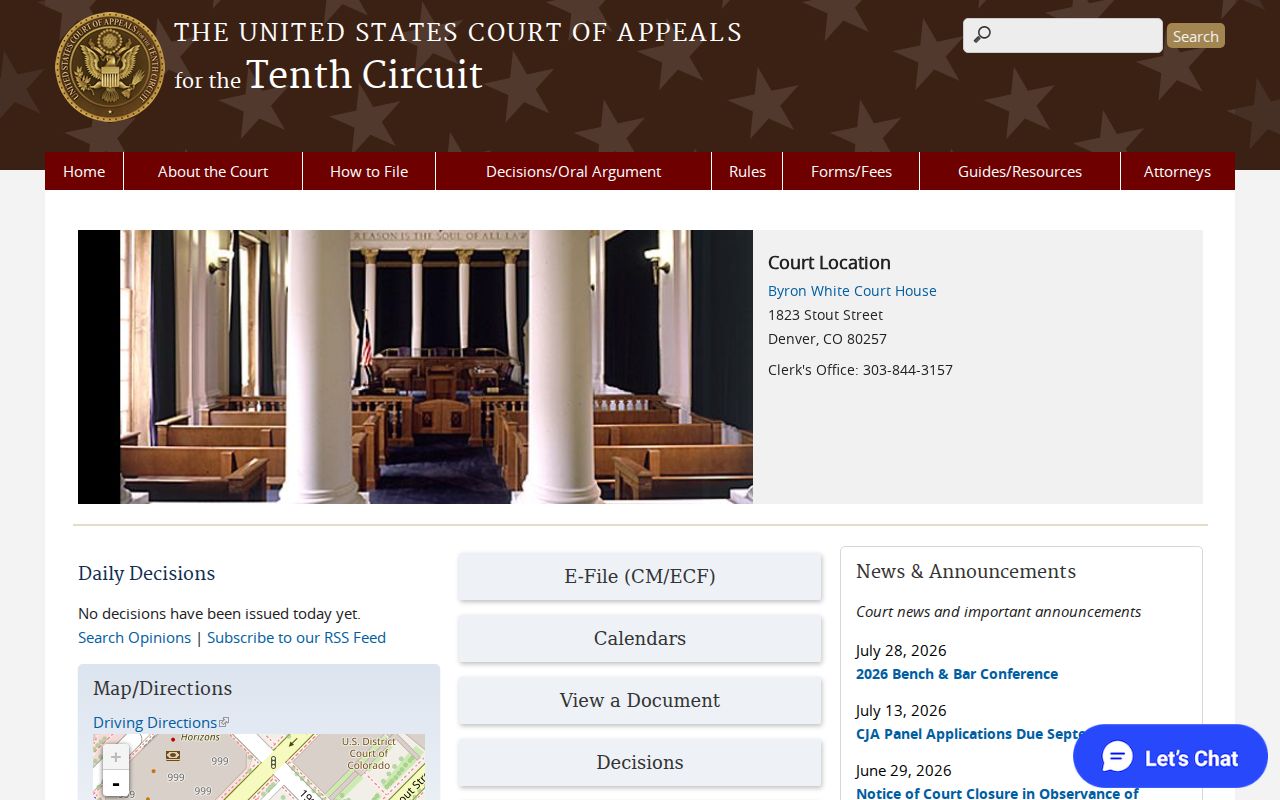
An appellate docket is its own federal case record. It replaces neither the district court docket nor any Teller County state Register of Actions.
What a Court Record Contains
Colorado prepares a Register of Actions for each filed case. What the public sees depends on case type and access rules. A Teller County court record typically names the court, division, parties, and filings. It also lists settings, court actions, and the outcome. The free calendar shows only part of that.
| Case number | Year, class, and sequence, such as 2026T… for a traffic class |
|---|---|
| Caption and parties | The formal case name and public party or attorney roles |
| Filings and events | Complaints, motions, notices, minute orders, pleas, judgments, and appeals as applicable |
| Settings | Date, time, hearing type, division, and appearance mode when recorded |
| Disposition | Judgment, conviction, dismissal, sentence, satisfaction, or other recorded outcome |
| Documents | Named filings may be requested from the clerk; the vendor ROA does not supply PDFs |
Exhibits may sit in a case file, though sealed or protected ones stay restricted. Personal identifiers and confidential financial, medical, or mental-health details can also be redacted from a public copy.
Teller County Court Record Proof
A hearing calendar entry is not the outcome itself. The docket may list a sentencing, an arraignment, or a status conference, but the scheduled date is not the signed result. Stale settings linger, too, when a hearing gets reset. For real proof in Teller County, ask the clerk for the disposition order, the judgment, or a certified Register of Actions.
Use the filed result: A docket entry locates the event, while the signed order or certified record establishes what the court entered.
Grab the case number first with the Teller County case search before you file any record request. No match? Work through spelling, court level, municipal routing, the case's age, and its access status before assuming nothing exists.
Certified Copies and Fees
A plain copy is just a reproduction of an open document. Certification costs more because the clerk authenticates it. An exemplified copy takes that a step further. Copy rates differ between the online and printable fee schedules. Your channel and requester status drive the price. The clerk sends a Notice of Fees before payment, and the printable request form is no place for card numbers.
| Item | Official Amount |
|---|---|
| Electronic or ordinary copy on current web form | $0.25 per page |
| Paper or court copy on printable schedule | $0.75 per page |
| Party or attorney copy | $15 maximum; no maximum for non-parties |
| Certified or exemplified copy | $20 per document, plus copy pages |
| Transcript of Judgment | $25 |
| Name or non-party search including ROA | $5 |
| Research or redaction after first hour | $30 per hour, billed in 15-minute increments |
Pulling an off-site file is billed at actual or varying cost. Postage comes in page bands, which means a large certified request can cost more to ship than to copy. The state fee list can change under statute, so trust the clerk's current estimate instead.
Teller County Court Record Timing
Timing varies. The current online form sets a three-business-day response target absent exceptional circumstances, and the older printable form says to allow three to five days. Neither figure promises the documents land in your hands that fast. Redaction, restricted-access review, certification, mail time, and older files stored off site can all stretch the job. Working with an old file? Ask for a cost estimate before approving retrieval. Ordinary research can arrive by email, while certified research goes out by mail, though the printable form also offers pickup. For a very large request, narrow it to the few filings that matter. The non-party copy schedule has no page maximum. Postage climbs with every page. Staff sends fee information only after review, so hold off on payment details by phone until your assigned researcher contacts you.
Teller County Court Records Clerk
Sheila Griffin serves as Clerk of Court and Jury Commissioner for Teller County Combined Court. Her state Judicial Branch office holds the files. It covers both Teller County District Court and Teller County Court. Don't confuse her with the elected Teller County Clerk and Recorder. That office handles land records and elections. It also handles marriage licenses and motor vehicles. Sharing a courthouse address doesn't make the Recording office the custodian of court files.
Clerk of Court, Teller County Combined Court
101 W. Bennett Avenue, P.O. Box 997
Cripple Creek, CO 80813
719-689-7360
Monday-Friday, 8:00 a.m.-4:00 p.m.
Call before you drive over, since counter service and public terminal availability can shift. The Teller County Courthouse location page also posts current closures or delays.
Public Access and Sealed Records
You see more Teller County court records at the courthouse than through remote search. Colorado Chief Justice Directive 05-01 and PAIRR 1 govern court case records, and criminal-justice access provisions or court rules can hold particular information back. So a record open for inspection may never appear in a public web search.
Key Rules:
Chief Justice Directive 05-01 governs public access, remote access, exclusions, vendors, and compiled court data.
PAIRR 1 and the Judicial Access Guide provide the court-case access framework and request routes.
C.R.S. Title 24 access laws distinguish general public records and criminal-justice records from judicial case-file rules.
Sealed criminal records stay out of public view entirely. Juvenile, adoption, dependency, mental-health, and protected records may be excluded or sharply limited, and civil material can be suppressed by rule or order. Probate access may demand identification plus proof of authority, and no court staff member can override a seal.
Teller County Court Records and CORA
A county-government records request is the wrong road to a judicial case file. CORA and PAIRR 2 cover other government or Judicial Branch administrative records, while Teller County court records follow PAIRR 1, Chief Justice Directive 05-01, and the filing court's own process. Send the case number and your document request to the Teller Combined Court clerk. Skip the county executive office. Skip the elected Clerk and Recorder, too.
Teller County Protected Court Records
A blank online result can mean lawful limits, not a missing file. CJD 05-01 permits remote access to be narrower. At a court facility you may see more. Staff may have to answer for sealed criminal matters as though no record exists. Protected documents can also omit personal identifiers, financial account details, and medical or mental-health information.
- Sealed
- Closed to public access by statute, rule, or court order.
- Suppressed
- Restricted from public view under a civil rule or order.
- Redacted
- Released with protected details removed.
- Off-site file
- An older record that may require retrieval at actual cost.
Use the clerk's form. Identify the case as fully as you can, and explain your authority for access when the material is restricted. Give identification only as directed, since release still depends on the governing law and order.