
How to Search Criminal Dockets
Hearing dates start free. The Colorado Judicial Branch Docket Search filtered for Teller County is a calendar only. It is not a full criminal case history. Choose Teller County and a short date range. Add at least one more filter. If you already know the case, split its number into the four-digit year, the class letters, and the sequence. A name search instead uses an individual party or attorney. Each result lists the hearing date and start time. It also gives duration, case number, hearing type, location, appearance field, and courtroom or division.
That calendar is not the whole story. A full Teller County criminal docket search needs a second path. The Judicial Branch directs the public to approved commercial vendors for real-time Register of Actions data. Those services are not the official record, and they do not provide filed-document copies. Use the official Record/Document Request Form instead. Choose Teller County, request an ROA, and select a disposition or sentence order, a protection order, or a ticket.
- Read the citation, notice, or pleading and confirm whether it names Teller Combined Court or a city municipal court.
- Search the free calendar with Teller County, a narrow date range, and a case, party, attorney, or division filter.
- Check the newest setting for its hearing type, courtroom, time, and appearance field.
- Use an approved vendor when the chronological criminal ROA is needed, then identify the exact order or filing by date and title.
- Request the official ROA or named document from the Teller clerk by form, email, phone, mail, or at the counter.
The web paths sometimes dead-end. When they do, the clerk can help directly. Email tellerclerkgeneral@judicial.state.co.us, call 719-689-7360, mail a request to P.O. Box 997, Cripple Creek, CO 80813, or visit the court counter in person. Before traveling, ask whether on-site electronic inspection is offered. No official source promises a particular public-terminal location.
Teller County Criminal Dockets by Court
Case class and charging authority decide which Teller County criminal docket fits a matter. The state District Court and County Court share one courthouse and a single Combined Court clerk. Their case families differ, though. City ordinance matters stay with the issuing municipal court. A city police ticket may still name Teller Combined Court, so trust the court and address printed on the charging paper.
| Court | Criminal docket scope | Search route |
|---|---|---|
| Teller District Court, Division 11 | Felony cases | State docket, vendor ROA, Combined Court clerk |
| Teller County Court, Division T | Misdemeanors and state traffic matters | State docket, vendor ROA, Combined Court clerk |
| Woodland Park Municipal Court | City ordinance, municipal traffic, and municipal criminal matters | Municipal coordinator and City Hall records |
| Cripple Creek Municipal Court | City ordinance, traffic, and municipal criminal matters | Municipal clerk and City Hall records |
Woodland Park sends DUI, driver-license, registration, and license-plate offenses to Teller Combined Court. Cripple Creek gives a similar warning. Its police may write some tickets into Combined Court. Because of those local quirks, a broad name search works poorly. Read the court named on the charging paper first.
Note: The court printed on a city citation controls whether to search the municipal docket or the Teller County criminal docket first.
What a Criminal Docket Shows
Colorado calls its chronological criminal case index a Register of Actions. A Teller County ROA identifies the case, the parties, and the division. It also lists filing status and public charge information. Events, settings, and any outcome entries available for release appear there too. The free calendar shows only the setting slice of that file. It leaves out pleadings and full charge detail. The financial ledger and downloadable documents are missing too.
| Case number | A year, class, and sequence such as 2026CR123; CR, M, and T identify observed criminal or traffic families. |
|---|---|
| Court and division | Teller County, with Division 11 for felonies or Division T for County Court matters. |
| Charges | Public offense, statute, level, and count information where accessible; a charge remains an allegation unless resolved. |
| Events | Complaint or information, advisement, bond, arraignment, motions, minute orders, plea or trial, sentence, and appeal entries. |
| Settings | Date, time, hearing type, division, and any stated appearance mode. |
| Disposition | Dismissal, conviction or judgment, deferred result, and sentence-order entries as the public record permits. |
Never treat a calendar result or vendor index as the signed outcome. Ask the Teller clerk for the disposition or sentence order. A certified ROA works as well. Certification is simply the clerk authenticating the record.
Teller County Criminal Docket Codes
Check the case-class code first. In Teller results, CR points to a felony, M to a misdemeanor, and T to a state traffic matter. Division comes next. A Division 11 entry and a Division T entry lead to different schedules and contacts, even though the same Combined Court clerk maintains both records.
- Advisement or First Hearing
- An early setting where rights, custody, bond, and the next step may be addressed.
- Arraignment
- The formal charge and plea stage.
- Minute order
- The court's recorded action or direction from a proceeding.
- Reset or continuance
- A change to a later setting; the older entry can remain in the history.
- Disposition
- The result of a charge or case, such as conviction, dismissal, or another lawful resolution.
Read related entries together. A bond order is not a disposition. A plea entry does not replace the signed sentence order. One dismissed count does not settle the rest. Check the outcome count by count against the later order.
Note: A blank appearance field in the public calendar does not grant permission to appear remotely.
Stages on a Criminal Docket
A Teller County criminal docket opens when a complaint or information starts the state case. Advisement and bond entries may follow. Arraignment records the plea stage. Motions and pretrial settings mark the work before trial. From there the case can move to a plea or trial, a disposition, sentencing, and later review or appeal. Not every matter uses each step, but the ROA preserves the order of events that actually occurred.
Criminal docket flow: Filing › Arraignment › Pretrial › Plea or Trial › Disposition › Sentencing
Settings change. Find the latest arraignment, first hearing, status conference, pretrial, trial, or sentencing entry. Then look for a later reset or vacated entry. The most recent court-issued notice or signed order beats an old printout every time. When two entries seem to conflict, the Combined Court clerk can confirm the division.
Note: A later reset or vacated entry matters. It can make an earlier Teller County criminal docket setting obsolete.
Teller County Criminal Bond Dockets
A Fourth District bond-hearing order creates a set schedule for one group of defendants. It covers people charged in Teller County. They are being held in custody outside the district. Those Division T bond hearings run at 1:00 p.m. Monday through Thursday. There is also a Friday session at 11:45 a.m. Holiday exceptions are built into the order itself. So this calendar is narrower than the public schedule most visitors see. It fits the custody situation the order describes.
For everything else, go to the Teller County criminal docket itself. That is where you confirm the actual setting, the division, and any later change. Remember what a bond entry means. An advisement or bond hearing sets release conditions and the next step, nothing more. It is not a finding of guilt, and it does not end the case. When the custody schedule and the online setting clash, call the Combined Court clerk.
Teller County Criminal Dockets in Recovery Court
The Fourth Judicial District runs its Recovery Court out of El Paso County Division L, and it serves both El Paso and Teller counties. It is a post-conviction program for adults whose substance-use disorder feeds their criminal conduct. Treatment, supervision, testing, and frequent review hearings form the core of it. Those events usually stay under the participant's original criminal case number. There is no separate public treatment database to search. The official Fourth Judicial District Recovery Court profile names the program whose review settings can layer onto an underlying Teller County criminal docket.
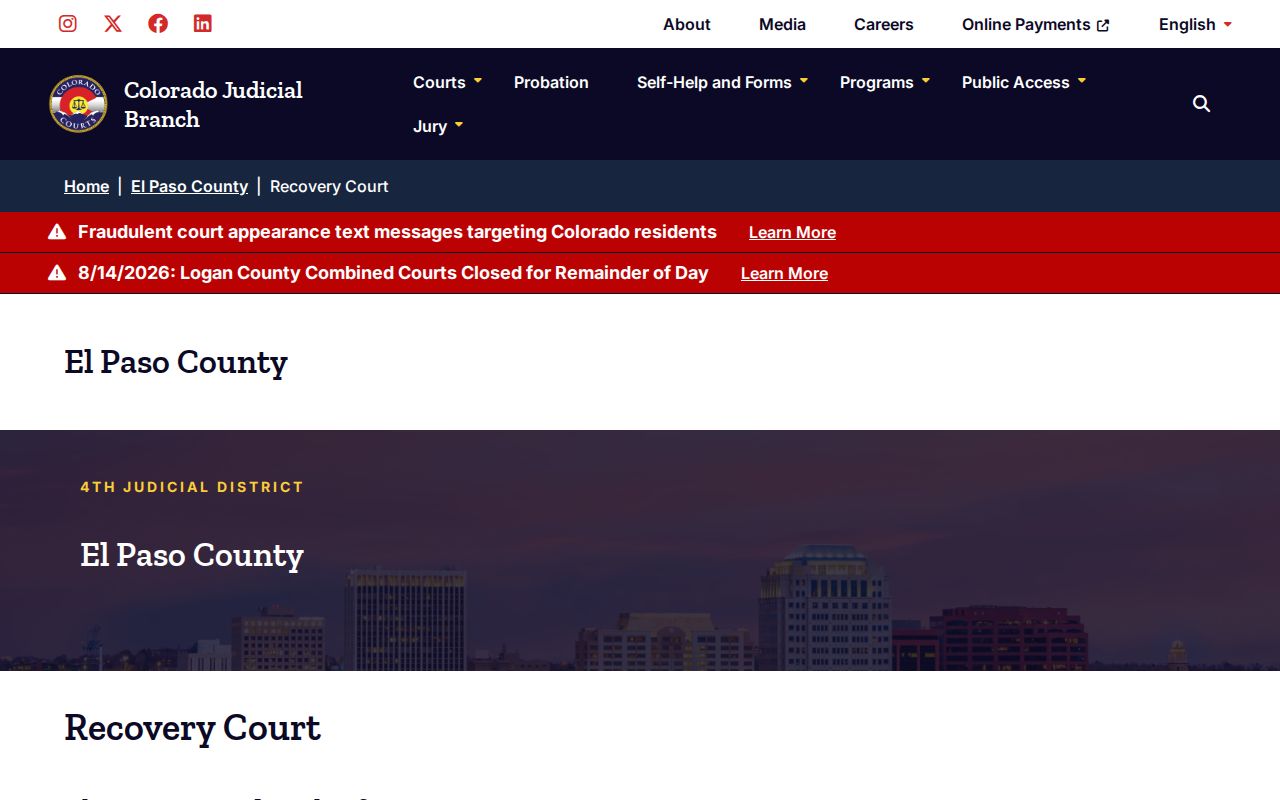
That program profile points one way. The clerk's case record goes further. It settles what is actually public in the underlying case. Orders, events, and outcomes get verified there, not in the program description. Open criminal proceedings normally follow remote-observation rules. Recovery Court is different. Its reviews can reveal substance-use and health details. The official livestream order documents how the court balances access against that privacy risk. An official 2024 release archive includes word of eight Recovery Court graduates. Even so, a public hearing setting never opens every treatment detail or protected file.
Teller County Criminal Docket Volume
The FY2024 Judicial Branch statistics put Teller County Court misdemeanor filings at 476. It lists 498 misdemeanor terminations too. The same report lists 30 felony filings and 30 terminations in its County Court category. Numbers like these describe the courthouse workload. They say nothing about the age, complexity, or result of any single Teller County criminal docket. A termination is a reporting category, plain and simple. It is not a verdict label. For how a matter actually ended, the criminal ROA and signed court orders are the source. That covers dismissal, plea, trial judgment, or another disposition. Annual totals give context; the case record gives the answer.
Which Court Holds Criminal Dockets
Felony dockets in Teller County sit with Teller District Court Division 11. It is part of the Fourth Judicial District. Teller County Court Division T handles misdemeanors and most state traffic matters. The Combined Court clerk keeps both state-court files at 101 W. Bennett Avenue in Cripple Creek. Do not confuse that office with the elected Teller County Clerk and Recorder. That office handles land records, elections, marriage licenses, and motor-vehicle work. It does not handle criminal court dockets.
Woodland Park Municipal Court and Cripple Creek Municipal Court each keep their own municipal criminal dockets. Those run under city code. Picking Teller in the statewide calendar will not surface those files. When a citation points to City Hall, contact that municipal clerk. A state-law charge or appeal can land in the state system. If it does, track the new state case number. Cross-reference carefully. Two captions that look alike are not always the same case.
Teller County Criminal Docket Reset Checks
An outdated setting can linger after a Teller County criminal docket changes. Start with the newest court notice you have. Then run a docket search over a short date range and read the ROA for continuance, reset, minute-order, or vacated entries. Compare what remains: the latest unvacated setting controls. The official Teller County court page posts local schedule notices along with closure and delay status.
Still unclear? For a felony, call Division 11 at 719-689-6926. For a County Court case, use the Division T general clerk line at 719-689-7360. A Teller traffic or misdemeanor ticket demands an in-person appearance on its printed date unless the court says otherwise. A virtual-room page alone does not authorize appearing remotely.
Setting warning: Teller court materials warn that failure to appear on a required ticket date may produce a bench warrant. Confirm any change with the court named on the ticket.
Public Access and Sealed Criminal Dockets
Public Teller County criminal dockets can be inspected at reasonable courthouse times. Access shrinks only when a rule, statute, directive, or court order limits it. Remote access is narrower still. Approved vendors feed real-time index and ROA data for public felony and misdemeanor matters, but that data is informational and carries no filed-document copies. For official records, the filing court is the source.
Key Rules:
Chief Justice Directive 05-01 governs public inspection, remote access, exclusions, vendor duties, and compiled court data.
PAIRR 1 and the Judicial Branch Access Guide provide the court-case access framework and distinguish judicial case files from administrative records.
Colorado criminal and juvenile record statutes permit limits when law, court rule, order, or protected status requires them.
A sealed criminal case stays out of public view. Under the directive, staff may answer as though no record exists at all. Juvenile records, suppressed material, and protected information can also be withheld. Before assuming a seal, consider simpler explanations. A misspelled name will produce the same empty result. So will the wrong court, an off-site file, a narrow date range, or the wrong case class.
Note: A missing online result can stem from a search issue. Storage, court routing, or a lawful restriction can cause it too.
Teller County Criminal Docket Transcripts
A Register of Actions won't give you the words spoken at a hearing. For that, you need the Fourth District's court-reporter or recording process. One hurdle comes first. Under Chief Judge Order 2025-01, a non-party must file a motion in the case and win the presiding judge's approval. Only then can the request go any further through the clerk or court executive.
Don't confuse this with ordering an ROA or a sentence order. Pull the Teller County criminal docket first to pin down the hearing date and the division that presided. Then run the transcript procedure for that proceeding. A calendar printout is no substitute for a transcript. And a transcript, in turn, won't replace the clerk's certified disposition.
Teller County Criminal Docket Official Copies
Sheila Griffin serves as Clerk of Court and Jury Commissioner for Teller County Combined Court. Her office keeps the state criminal case record. It can issue an ROA, a disposition or sentence order, a protection order, or a ticket where access allows. For remote requests, the online form is the best documented route. It asks who you are, and names Teller as the record location. It also wants the case number, the document you're after, and whether you need certification.
Teller County Combined Court Clerk
101 W. Bennett Avenue
P.O. Box 997
Cripple Creek, CO 80813
719-689-7360
tellerclerkgeneral@judicial.state.co.us
The clerk's stated target is three business days for a routine response. Mail, email, phone, counter service, and possible on-site inspection still work. They remain options when the form or the vendor can't resolve a file. Older records may sit off-site, and retrieval runs at actual cost. Non-party transcripts go a different way. File a motion, get the presiding judge's approval, then proceed through clerk or court-executive channels in the Fourth District. Note: a criminal-history response from CBI is not the same record as a Teller court ROA. It isn't a filed criminal order either.